Monday, 31 August 2015

How come we all don't know about All Hallows Wellingborough??!

On a recent visit to see a friend we popped into this church. What a stunner, a Grade 1 listed building with the most astounding collection of the pioneering 'big names' of modern stained glass (rubbing alongside and not forgetting the famous Victorian studio of James Powell and Sons, Whitefriars!). Sadly my pictures were not great and if you visit this church I would love to update this blog, credit you and feature any better stained glass photos you have.

First this window by Jean Barillet, son of Louis Barillet (see earlier blog post), the sun was blazing through the strong colours of these panels dedicated to St Crispin and St Crispinian, patron Saints of the boot and shoe making industry, making the figures vivid and intense.


Looking for information on Jean Barillet I came across this write up stored in The Universal Digital Library;

The young Parisian Stained Glass Artist Jean Barillet
succeeded a few years ago his father Pierre Barillet, a great
artist himself who lived his whole life among the most brilliant
gathering of French painters such as Matisse, Vlaminck,
Utrillo; and was the first to foresee the tremendous possib-
ilities that modern Painting can bring to the art of Stained Glass.
Jean Barillet carries on, in the studio built by his father,
researches in the artistic and technical fields of his activity.
He was the first to try out and expand the fascinating
new process consisting of thick slabs of coloured plate glass set
in cement, thus, curiously enough, coming back through the
ages to the simplicity and the slightly primitive means of
expressing their Faith of the middle-Ages old Masters.
Recently, Jean Barillet contributed, with the well-known
French painter Fernand Leger, huges pannels of cement-set
glass meant for the experimental Church of Audincourt; thus
placing Stained Glass at the Spearhead of modernism.

Jean Barillet (1912 - 1997) had an extensive and impressive career working in Basilicas, Cathedrals and Churches in many countries including the Cathedral of Notre Dame in Paris, The Cathedral of St Joseph in Hartford USA, Church of Audincourt (France) and many many more.  

Evie Hone (1894 - 1955) was an Irish stained glass artist described by the Tate as 'an outstanding religious painter of modern Ireland and a stained glass artist of international stature'. In All Hallows she made the Alice Maud Middleton Memorial Window with ideas and symbolism based on the Creation.
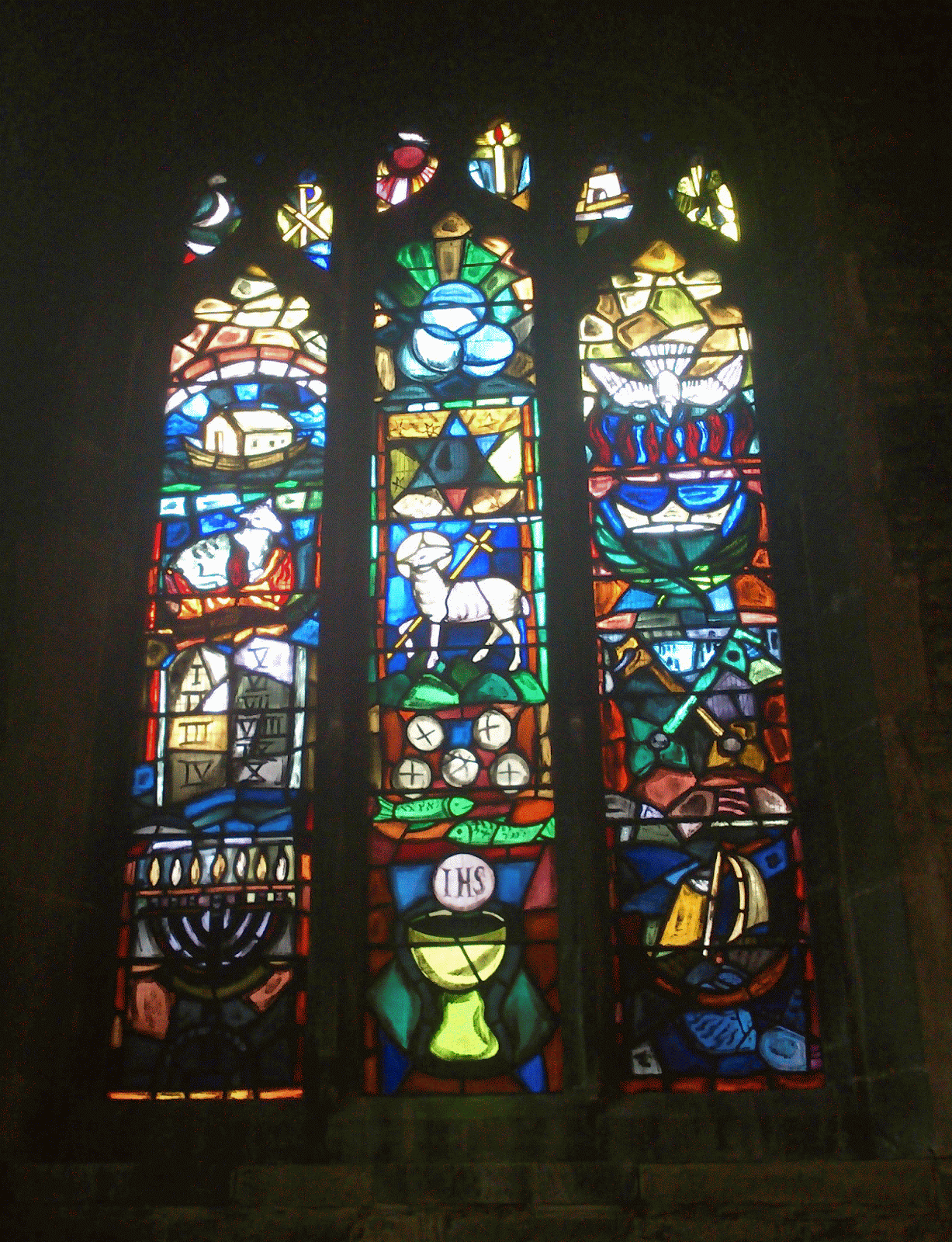


Evie Hone created many stunning windows including 'My Four Fields Green' showing the 4 symbols of the provinces of Ireland and this work is now in Government Buildings, Office of the Taoiseach, Dublin and a huge and complex window in the chapel of Eton College, Berkshire.

John Piper another famous stained glass artist has three windows in this church; the Rose Window (which sadly I did not see - any photos appreciated!), the Constance Chapman Memorial Window and the Helen Wells Chapman Memorial Window, all three were executed by Patrick Reyntiens. The windows date from 1961 to 1969 and you can see how much his style developed in this period. The first of his windows was the Helen Wells Chapman Memorial Window 1961 below;


this is his later Constance Chapman Memorial Window from 1969 about which he said "It is what you make it to be";


John Piper with Patrick Reyntiens, created the windows at Coventry Cathedral, the chapel of Robinson College Cambridge and the Washington National Cathedral amongst many others. On this sunny day they proved their absolute skill in working colour, light, shape and form.

All Hallows Church is the oldest existing building in Wellingborough dating from c. 1160, you can find it on the Wellingborough Council Heritage Trail and there appear to be occasional tours of the stained glass advertised on the All Hallows Facebook page.

Sunday, 2 August 2015

Old English Muffle

I've just completed a repair on a simple diamond quarry patterned glass. The panel was primarily made with old English Muffle. The lovely glass has a history that stretches right back to the factory style stained glass industries of the Victorian era. It is still made today though the original daisy pattern has morphed into a kind of coffee bean hammer effect. The colours also have changed being softer and more muted originally (though with some surprising bright colours thrown in) to much brighter and stronger colours now. One of the most attractive properties of the old version is the way that the pattern can vary so much sheet by sheet so it can appear very flat but also very rippled so you end up with some very lively panels shifting in texture but all using the same glass. Here is the rebuild I just completed;

 
and here are a couple of panels I rebuilt showing the beautiful subtle old colours. 

 
and below in the rectangles is the new version of this glass, ever popular for it's good obscurity and pleasing pattern today!


Saturday, 25 July 2015

The Night Watchman

'The Night Watchman' was a collaborative work commissioned by the artist Terry Scales. Based on a painting from the 1950's the original piece had a colourful life being stolen whilst being exhibited at Sweetwaters Fine Art in W1 (you can read more about this here). Terry wanted to recreate the mood of the piece but in a different form. Terry gave me a photo from which to scale up the lead lines. I then got out a ranges of glasses based on the original colours and Terry chose the ones he most liked. The glasses were then cut and went to Terry for painting and silver staining, then returned to me for leading and cementing. At 81 years young this is Terry's first stained glass piece...


The original painting - if anyone knows the whereabouts of this painting please notify Terry!
 

Thursday, 16 July 2015

Up close with the Ancestors of Christ

The stunning Ancestors of Christ exhibition is on until 23rd August at Canterbury Cathedral. Here is a collection of medieval images from the 22 panels on show and more generally from the Cathedral. Originally there were 86 ancestors, combining 77 from Luke's gospel and 8 from Matthew's. 43 of the original ancestors survive in total. Dating stained glass is not easy as carbon dating or material analysis is not a precise tool but combined with stylistic and historical evidence it is estimated that the panels range from circa 1130 to circa 1200. The panels are highly skilled with complex design work and show a beautiful fluidity and range of painting style. The expressions are animated and intense - perhaps the closest we will get to the medieval mind?
 
Abraho

Boaz
The lost hand in this panel reflects the removal of the panels from their original clerestory location and relocation into the late 14th century West Window and the Great South Window. The move resulted in the order of the ancestors being confused, fathers and sons split up and the detailed ornamental borders being removed and hands and feet amputated in order to fit the new surround. 

Enoch
The panels were painted by different artists, their names lost but thought to be French. Some panels are distinctive in their style; Enoch, Methuselah, Adam, Lamech and Noah are thought to be painted by the 'Methuselah Master' who had a sculptural, animated style with a naturalistic feel.

Esrom

Ezechias

Her

Jareth

Jesu

Joseph

Josias

Jude

Lamech

Matusale one of the earliest figures made after the fire of 1174.

Nathan - parts of this panel could predate 1174.

Ragau

 Thare
 
Detail from the Adam Delving panel circa 1176 in the Clerestory window. 

Wednesday, 1 July 2015

Sue King is all in the pink!

I popped in to see my friend Sue King who has a studio in the same building as me in Cockpit Arts Deptford today. Sue is currently raising funds for Salisbury Hospital Breast Cancer Care Unit and her studio is swimming in pink stars and hearts...


hot off the press!


These stars and hearts are beautifully packaged and the stars are for sale at £10 each (+£2.50 p&p) with £5 going towards the fund. The hearts are £12 each (+ £2.50 p&p)* with £6 going towards the fund. You can find out more about Sue's fund raising and place your order here http://suekingglass.co.uk/all-in-pink/
 
Below is another project just going into the kiln for Moorfields Eye Hospital
 
 A whirlwind of creativity in SE8!

The excitment of Wimbledon...

is too much for my glassy friend Susie Parkes... strawberries and brightly coloured tennis balls are the order of the day!


Sunday, 28 June 2015

Security Glass or no security glass...

I'm often asked for advice about whether to have the extra layer of glass which acts as a security measure in addition to the stained glass panel. Stained glass panels beyond a certain size need support whether this is via the traditional method of bar attached to the panel or with a supporting layer of glass. In addition to the structural support, using toughened or laminate glass as an added layer also acts as a security measure and if security plays on your mind a lot then it could be the option to go for. If you do decide to have supporting glass then you need to decide whether to have the glass at the front or at the back of the stained glass i.e internal or external. If you have the glass at the front then your panels will look like this;


and this...


and this...


Internal view below with additional later fanlight!


 You can see that the fronting glass is very visible and an obvious deterrent. There is now the option of Heritage Glass which is non reflective. Heritage Glass isn't a glass that I would recommend. It's made by sandwiching 2 sheets of 2mm glass with a plastic film in between. 2mm glass is very fragile and can be broken easily. If a burglar can't see the glass and tries to break the stained glass, then you have the cost of replacing the Heritage Glass (and it is much more expensive than toughened glass and not commonly available) and also the possibility of damage impact to the panel as the burglar might not get through but unlike toughened glass, laminated glass does bow on breaking. For me the small advantage of being able to see the lead and glass surfaces in the daytime does not outweigh the advantage of having strong and durable toughened glass that is very hard to impact from the surface. 

Typically it is only the lower panels that have the extra layer of glass as you need to be able to read any fanlight numbers without that surface bounce of light off the glass (and it's unlikely that someone would enter from that height!). In the daytime from the inside, for you looking out, the panels won't look any different and at night when your hall lights are on the fronting glass won't be visible from the outside view.

Night shot from outside - no different.

Some people opt to have the glass on the inside. Reasons for this are usually that the customer likes the old world look of lead and glass, which you cannot see so clearly with the fronting glass. It could also be that the whole street has panels set like this and you are blending into the street look or that you are in a conservation zone and have particularly nice brickwork and features at the front which tend to be enhanced by the visible stained glass. Below are some views of panels with glass behind;


This job was more tricky than most with the right angle shapes which present a weak spot if cut freehand, so the toughened glass was waterjetted to get the right angles and the door was made new to accommodate both layers of glass. In the daytime from the inside the extra layer doesn't notice. (An exception to this would be where there is bright light within the hallway from adjacent window/s and light falls on the glass - then you would see some surface reflection).

Glass on the internal side.
Below are 2 jobs with slimline double glazed units behind the external stained glass - an added layer!

Slimline unit behind the fanlight only.

Textures of glass and lead...

Slimline units behind new woodwork and letterbox - being installed! The stained glass is a little further away so you do not have the immediacy of viewing through a single layer.
St James's Piccadilly - just a beautiful example of surface texture using the 'bendy' Crown Glass. You can really see how the light hits at different angles. In some old panels this effect was deliberately achieved by placing the glass at different angles in the lead in order to catch the light differently as your eye passes over. 

The photo below sent to me by a customer illustrates a possible risk of having the supporting glass on the inside. The glass is just as secure but not visible from the outside so not an obvious deterrent.
An attempted break in meant that 4 pieces of glass were broken but because of the toughened glass behind no entry was gained. Unfortunately for the customer there is now the cost of removing both the unbroken toughened glass and the stained glass in order to repair the broken pieces. One way to lower the risk of attempted burglary is to have added security features for example, double lock, external light, camera. Your local Neighbourhood Watch or the Police have good information leaflets on this.
There is no hard and fast rule to 'which way round' but if you are more concerned with security than getting that traditional look then you probably should opt for peace of mind and have the security glass on the outside.