Showing posts with label Hatcham Manor Estate. Show all posts

Saturday, 22 January 2022

Transformation!

 It's always a pleasure to work on the beautiful houses in New Cross, London. The work consisted of a new door set of panels with fanlight above and separately a dining room fanlight.
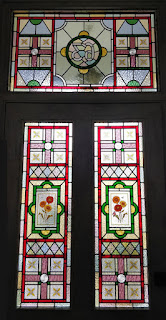
Photo Courtesy of Tracey Gobey.
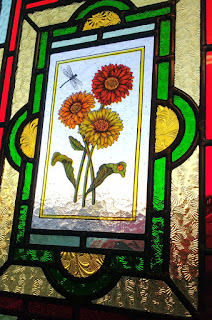
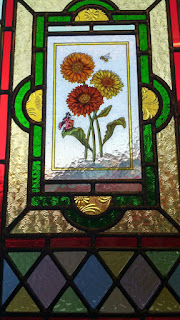
The design is adapted from the street design with preferred colours / textured glasses chosen. Some original Victorian glasses were recycled and built in; the amber Japanese around the painted centres and plum coloured Muranese cross shapes. 


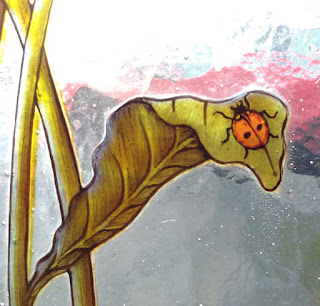
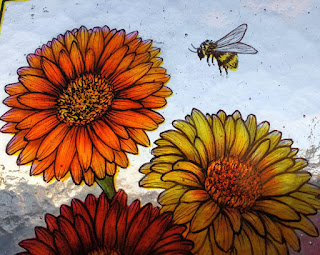
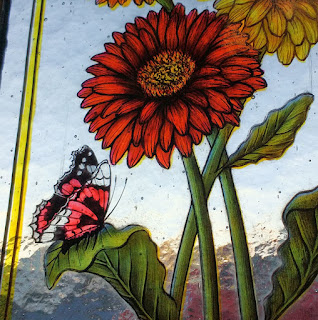
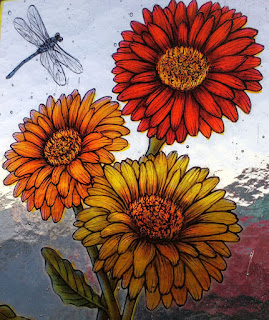
The beautiful painted centres with Gerbera flowers and 4 insects hold significance for the customers and were exquisitely painted by Flora Jamieson.


The dining room panel is an adaptation from an original Victorian sun design panel.
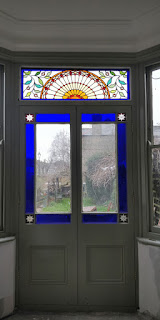
Photo courtesy of Tracey Gobey

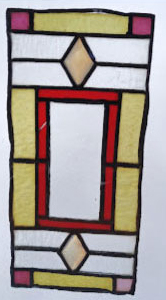
It incorporates some antique diamond shaped jewels from 2 sets of lantern panels (photos below) and recycled glass from some Pinewood Studios panels used in the set for the recent film Black Widow!
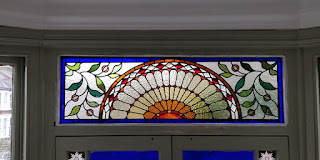
Photo courtesy of Tracey Gobey
All fitting by the amazing John Mahoney.
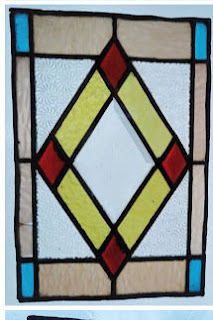

Lantern panels salvaged by a keen eyed friend! 
Tuesday, 26 October 2021

New Cross - New Door Set!

 I have written about the beautiful panels of this area previously here Apollo Stained Glass: Space Age New Cross! One of the lovely aspects of matching the street style is the opportunity to change both the colours and painted centres making the panels both traditional and unique.

Before

Bespoke artwork for the painted centres by Flora Jamieson.

After!

Wednesday, 28 February 2018

"Pictures have voices that the soul can hear"

In the 1870s the Haberdashers Company laid out the plans for Hatcham Manor Estate in (now) New Cross, London. The houses were designed as high quality residences with beautiful traditional stained glass in the front doors much of which remains...


For the internal decoration of doors one of the builders at least, used the services of an American company based in William Street, New York to supply a variety of printed transfers, giving the illusion of stained glass....


With different designs being used across the estate...


This technique became very popular in the Victorian era and a variety of different manufacturing processes over many years led to it being called various names e.g. "Crystograph", "Glacier", "Vitramanie" and Diaphanie". As the extract below illustrates it was exciting and new and was expected / hoped to fast supersede fusty old (traditional) stained glass.

Jones, C.S., Mrs., and Williams, Henry T. Household Elegancies: Suggestions in Household Art and Tasteful Home Decorations. 4th ed. New York: Henry T. Williams, 1877. "Transparencies on Glass, Etc.": "Vitremanie": p. 25.

Depending on the process being used sometimes the paper transfer was left on and 'cemented' to the backing glass while with later techniques the paper was removed and just the print remained on the glass. With the Hatcham Manor Estate panels the paper is still there. Photos sent to me of other panels in the same estate show clean breaks but there are also water marks and leaching on the panels that I was working to preserve and a fragment that I was given clearly had paper remaining.

Clean breaks...

leaching...

Though this type of work may be cheaper then traditional stained glass, because the glass 'sandwich' is so thin, perhaps just over 1mm deep, when it breaks the whole piece is damaged. Whereas with stained glass individual pieces can be replaced and the whole preserved much more easily.

Fortunately the damage to the panels I was asked to help preserve was not as bad as the badly cracked one above with single and a few multiple cracks but hanging together...

Single (above) and multiple cracks (below).


It seems impossible to find anyone to replace or repair this glass so the best hope was to preserve and protect it by putting 4mm toughened glass into the sight line both sides. Laminate film was also recommended but with the cracks and the water marks it didn't seem a good idea to get water near it (for floating / placing the film). End result the panels will hopefully be secured for many more years...


Transfer glass never achieved the expectations of its early enthusiasts, it never got to provide "a daily word of wisdom that will speak openly to every member of the household on sacred or historic themes, or the beauties of creation". In domestic glass it is relatively rare now and little is still known of the intricacies of the processes. Fortunately there are some great sources of information and if this post has interested you and you would like to find out more check out the excellent article 'The Conservation of Chromolithographic Windows in St Benet's Chapel, Netherton and the Origins of Transfer Printing on Glass' by Mark Bambrough in The BSMGP Journal vol XXXIX. You can order article reprints from the BSMGP here; http://www.bsmgp.org.uk/Publications/.

Thank you Paul Chasse, librarian from the Corning Museum of Glass for researching my request for info and sending a copy of Household Elegancies amongst other fascinating Victorian reference material. What a truly excellent service you provide.

If you live in the area and have any photos of this type of glass or any further information to add please feel free to get in touch and I will post your photos / info at the end of this blog.

Thursday, 22 December 2016

Beautiful original door set

It's always a pleasure to work on a virtually intact original Victorian door set. This set of panels was very dirty and mainly needed minor repairs, recementing and a very good clean up! The front of the panels has a decorative effect applied to the surface of the lead called 'silverfinger'. This gets a little tired looking after a while and needs renewing. Gold was another popular Victorian colour again applied to the surface of the lead.


All above photos courtesy of Felicity Robinson.